

Canada’s permanent residence numbers in 2026 are published by Immigration, Refugees and Citizenship Canada (IRCC), updated as the year goes on, and far quieter than the noise around them.
Hopeful applicants hear a different version of the country’s immigration plan every week, and most of those versions come from a headline rather than the source.
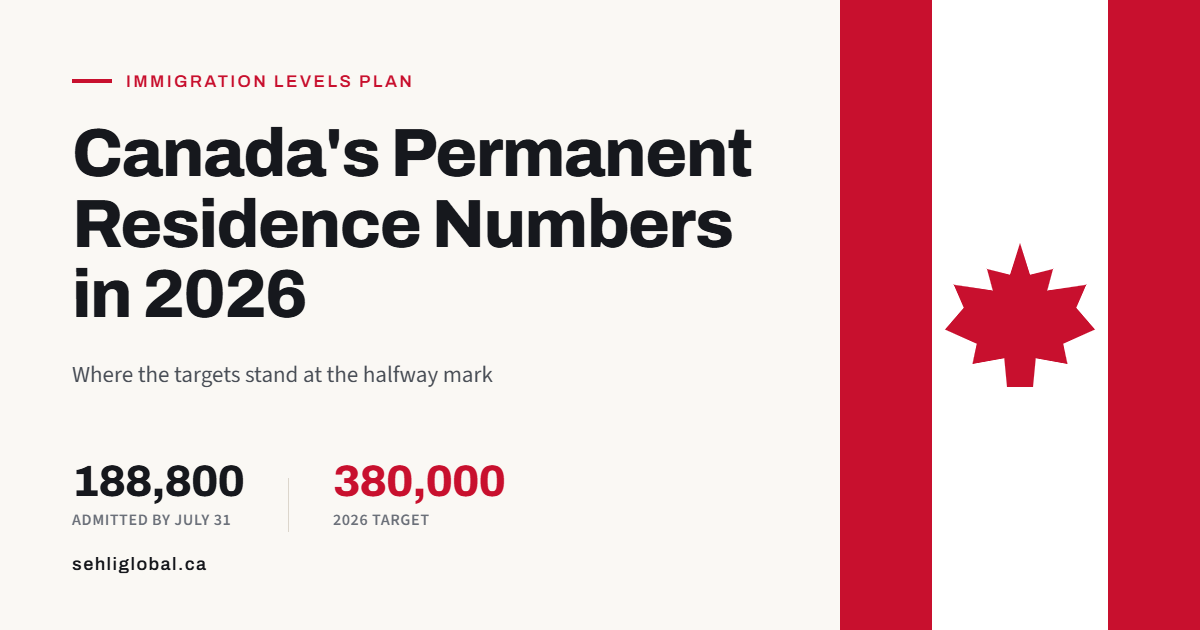
According to IRCC data current as of July 31, 2026, Canada has welcomed 188,800 new permanent residents since January under its Immigration Levels Plan, against a full-year target of 380,000.
Everything below comes from that same source and that same date.
What the Immigration Levels Plan is actually for
The Levels Plan is the document that decides how many people can become permanent residents in a given year and how those spaces are shared out between different types of applicants.
Because it is set out in advance but reviewed each year, it gives the government room to shift with changing priorities and pressures rather than being locked into one formula.
The direction of travel is deliberate. Canada has committed to returning immigration to what it calls sustainable levels, stabilising new permanent residents at less than 1% of the total population beyond 2027.
The emphasis has moved toward granting permanent status to people who are already here, living in Canada, working in Canada, and paying into the economy.
That last point matters more than it sounds. In recent years, roughly half of all new permanent residents were already in the country as non-permanent residents before their status changed.
They were already renting homes, already using transit, already registered with a doctor. Granting them permanent residence changes their paperwork, which is precisely why this approach eases pressure on housing, infrastructure and social services instead of adding to it.
How the 380,000 spaces are divided
The plan splits this year’s spaces across four categories, each serving a different purpose.
| Category | 2026 target | Admissions Jan–Jul 2026 |
|---|---|---|
| Economic | 239,800 | 109,600 |
| Family | 84,000 | 52,900 |
| Refugees and protected persons | 49,300 | 21,800 |
| Humanitarian & Compassionate and Other | 6,900 | 4,400 |
| All categories | 380,000 | 188,800 |
Source: IRCC, as of July 31, 2026. The figures are approximate and some values may be rounded, so individual category totals may not always add up exactly.
Economic
It helps to be clear about what this term means, because “economic permanent residence” gets used constantly and explained rarely.
These are people selected through work-based and regional economic immigration programs.
The reason they were chosen is tied to what they do, meaning their skills, their work experience, or the fact that a particular province or region needs them.
It has nothing to do with wealth and everything to do with labour. A nurse selected through a provincial program and a software developer selected through a federal one both arrive as economic permanent residents.
This is the largest category by a wide margin, holding nearly two-thirds of the year’s spaces. Canada set a target of 239,800 economic permanent residents for 2026 and admitted 109,600 of them between January and July.
Family
The family class exists so that Canadian citizens and permanent residents can sponsor certain family members to join them permanently in Canada.
It is also the category where applications are most often derailed by avoidable mistakes, which is why it is worth understanding how IRCC assesses a relationship and what it treats as marriage fraud before you file.
It is the smaller of the two large categories but the one furthest along against its target this year. Canada set a target of 84,000 family class permanent residents for 2026 and admitted 52,900 between January and July, roughly 63% of the year’s spaces filled by the end of July.
Refugees and protected persons
These two groups are often mentioned together, but they reach permanent residence by different routes.
Resettled refugees are identified abroad and referred to Canada by the United Nations Refugee Agency, by private sponsors, or by other referral partners. They arrive in Canada already holding permanent resident status.
Protected persons are already inside the country. They have been granted protection either by the Immigration and Refugee Board of Canada or through IRCC’s pre-removal risk assessment process, and from there they can apply to become permanent residents.
Together, the two groups have a 2026 target of 49,300, with 21,800 admitted between January and July.
Humanitarian & Compassionate and Other
This category covers applications made on humanitarian and compassionate grounds, people caught up in international conflicts, crises and natural disasters, and other exceptional circumstances where an applicant would not be eligible under any other program.
It holds the smallest allocation in the plan, with a 2026 target of 6,900 and 4,400 admitted between January and July.
The French-language target outside Quebec
Running across the whole plan is a separate commitment to francophone immigration. In 2026, Canada is aiming for 9% of new permanent residents settling outside Quebec, about 30,150 people, to be francophone or bilingual.
The goal sits inside the Levels Plan and aligns with the Policy on Francophone Immigration, pitched to be ambitious without being unrealistic.
By the end of July, 14,900 new French-speaking permanent residents had settled outside Quebec.
For applicants, this target is not abstract. It feeds directly into how French ability is rewarded in selection, which we covered in our breakdown of the extra CRS points available to French speakers.
Two one-time initiatives sitting outside the plan
Here is the detail most summaries miss.
Alongside the Levels Plan, Canada is running two one-time initiatives across 2026 and 2027, and the people admitted through them are in addition to the 380,000.
They are not counted inside the 2026 to 2028 targets, which is why the total number of new permanent residents this year will be higher than the plan alone suggests.
We first wrote about both programs when they were announced, in Canada’s New 2026 Immigration Programs: Protected Persons and Skilled Worker Pathways.
Both exist to support a second commitment, reducing Canada’s temporary resident population to less than 5% of the total population.
Accelerating permanent residence for skilled workers already here
The In-Canada Workers Initiative is fast-tracking permanent residence for 33,000 workers already contributing in in-demand sectors, with particular attention to those who settled in smaller communities rather than the big cities. At least 20,000 of them are due to be admitted in 2026, with the rest following in 2027.
To be in scope, a worker needs to have been living in a smaller Canadian community for at least two years, and to have applied for permanent residence through one of these programs.
- Provincial Nominee Program
- Atlantic Immigration Program
- Rural Community Immigration Pilot
- Francophone Community Immigration Pilot
- Home care worker (caregivers) pilots
- Agri-Food Pilot
Both conditions have to be met, not one or the other.
Against a 2026 target of 20,000, IRCC had admitted 13,000 workers through this route by July 31, putting it 65% of the way there.
Offering stability to people with protected status
The second initiative runs for two years and will process permanent residence applications from up to 115,000 eligible protected persons and their in-Canada dependants.
These are people whose need for protection has been formally recognised and who cannot safely return to their country of origin.
Eligibility falls to two groups. The first is people granted protected person status, either by the Immigration and Refugee Board of Canada on an asylum claim or by IRCC through a pre-removal risk assessment, who have since submitted a permanent residence application.
The second is their dependants, meaning a spouse, common-law partner or child already living in Canada and listed as an accompanying dependant on that application.
Applicants who will be living in Quebec are not eligible for processing under this initiative.
Against a 2026 target of 46,000, IRCC had admitted 20,900 people through this initiative by July 31, or 45% of the way there.
Canada’s permanent residence numbers in 2026, month by month
Combining the Levels Plan with both initiatives is the only way to see how many people are actually becoming permanent residents this year.
| Month | Levels Plan | Protected persons initiative | In-Canada workers initiative |
|---|---|---|---|
| Jan 2026 | 21,715 | 920 | 1,590 |
| Feb 2026 | 26,115 | 1,175 | 2,000 |
| Mar 2026 | 25,745 | 1,730 | 2,155 |
| Apr 2026 | 27,000 | 1,620 | 1,270 |
| May 2026 | 28,485 | 3,845 | 2,095 |
| Jun 2026 | 27,155 | 5,730 | 1,960 |
| Jul 2026 | 32,565 | 5,865 | 1,935 |
| Jan–Jul total | 188,800 | 20,900 | 13,000 |
Source: IRCC, as of July 31, 2026. The data is approximate and subject to change.
Two things stand out in the monthly pattern. Admissions under the Levels Plan alone are running below where they sat in the same months of 2025, when July brought 38,735 new permanent residents compared with 32,565 this July.
That is the stabilisation policy showing up in the numbers.
At the same time, the protected persons initiative has grown sharply since spring, from 920 admissions in January to 5,865 in July, which is why total monthly admissions have climbed even as the plan itself tightens.
IRCC has published monthly admissions on this basis back to January 2023, and the longer run shows the same downward shift.
Monthly totals frequently passed 40,000 in 2023 and reached 50,945 that January. Through 2025 they sat mostly in the 30,000s, closing the year at 24,065 in November and 26,060 in December.
What this means if you are planning an application
The shape of the plan rewards people who are already inside Canada and already working, particularly outside the largest cities.
Between the economic category’s dominant share, the smaller-community focus of the In-Canada Workers Initiative, and the push on French-speaking admissions outside Quebec, the clearest routes this year run through skills, location and language rather than volume.
Conclusion
Canada’s permanent residence numbers in 2026 do not tell a story of doors closing. They tell a story of doors changing shape.
The country still intends to welcome 380,000 new permanent residents this year, with tens of thousands more arriving through the two one-time initiatives, and it reached 188,800 of that figure by the end of July.
What has changed is who those spaces favour, and the answer is increasingly people already living and working in the country, in the sectors and regions where they are needed most.
That makes the second half of the year the part worth watching. Just over half the plan’s spaces were still open when these figures were published, and how they are filled will set the tone for the 2027 and 2028 targets that follow.
All figures in this article are drawn from Immigration, Refugees and Citizenship Canada and are current as of July 31, 2026. IRCC notes that its data is approximate and subject to change.


Leave a Comment