
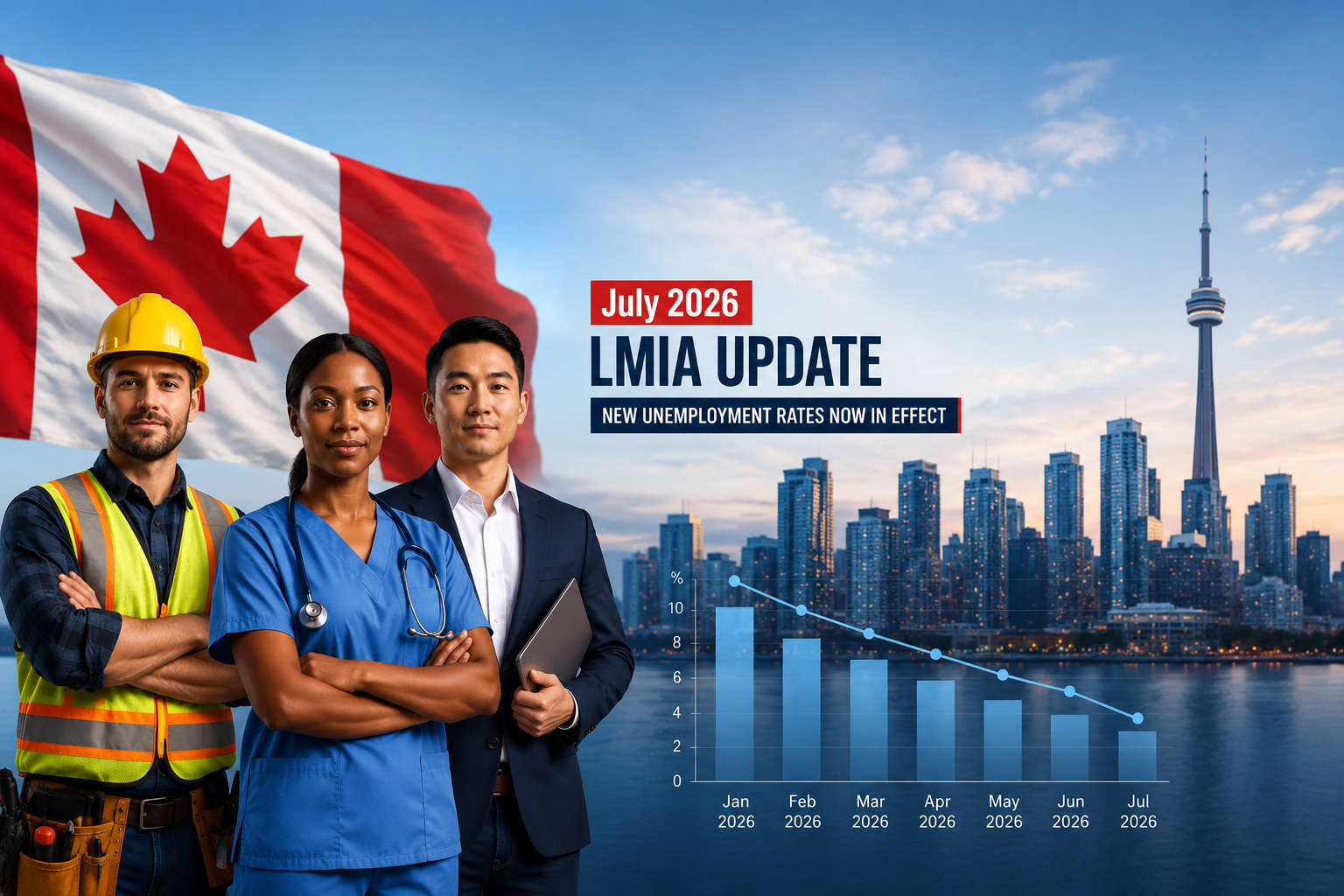

The Government of Canada has updated the unemployment rates used to determine whether certain Low-Wage Labour Market Impact Assessment (LMIA) applications will be processed under the Temporary Foreign Worker Program (TFWP).
The updated rates became effective on July 10, 2026, and will remain in force until October 8, 2026. The next quarterly update is scheduled for October 9, 2026.
For Canadian employers relying on temporary foreign workers, these quarterly updates are an important consideration when planning recruitment and submitting LMIA applications.
What Is the Refusal-to-Process Measure?
Under the Temporary Foreign Worker Program, Employment and Social Development Canada (ESDC) may refuse to process Low-Wage LMIA applications for positions located in a Census Metropolitan Area (CMA) where the unemployment rate is 6.0% or higher, unless the position qualifies under one of the program’s exemptions.
This policy is intended to encourage employers to recruit available Canadian citizens and permanent residents before hiring temporary foreign workers in regions experiencing relatively high unemployment.
Employers should verify the applicable unemployment rate before submitting a Low-Wage LMIA application, as eligibility is based on the unemployment rate in effect on the date ESDC receives the application.
July 10, 2026 Unemployment Rate Update
The latest Statistics Canada Labour Force Survey indicates that many of Canada’s largest metropolitan areas continue to have unemployment rates above the 6% threshold.
Ontario
| Census Metropolitan Area | Unemployment Rate |
| Toronto | 7.3% |
| Oshawa | 8.5% |
| Hamilton | 6.9% |
| Kitchener-Cambridge-Waterloo | 8.1% |
| London | 7.8% |
| Windsor | 7.9% |
| Barrie | 7.9% |
| Peterborough | 7.0% |
| Greater Sudbury | 6.2% |
Below the 6% threshold:
- Kingston – 5.3%
- Thunder Bay – 4.9%
- St. Catharines–Niagara – 5.8%
British Columbia
The following metropolitan areas remain above the threshold:
- Vancouver – 6.7%
- Abbotsford-Mission – 8.0%
- Chilliwack – 7.9%
- Kelowna – 7.5%
- Kamloops – 7.0%
- Nanaimo – 6.5%
Victoria remains below the threshold at 4.6%.
Alberta
- Calgary – 7.0%
- Edmonton – 7.2%
- Red Deer – 7.2%
Lethbridge is below the threshold at 5.4%.
Quebec
Montréal remains above the refusal threshold at 6.8%.
Other major Québec CMAs remain below 6%, including:
- Québec City – 4.0%
- Sherbrooke – 4.3%
- Saguenay – 3.4%
- Trois-Rivières – 5.3%
Atlantic Canada
CMAs exceeding the threshold include:
- Moncton – 8.1%
- St. John’s – 7.3%
The following remain below 6%:
- Halifax – 5.9%
- Fredericton – 5.3%
- Saint John – 5.9%
What Does This Mean for Employers?
A higher unemployment rate does not automatically prohibit employers from hiring foreign workers. Rather, it may prevent ESDC from processing certain Low-Wage LMIA applications, depending on the occupation and whether an exemption applies.
Several occupations and sectors remain exempt from the refusal-to-process measure, including certain positions that support:
- Food security and primary agriculture
- Healthcare services
- Construction
- Other occupations identified by the Government of Canada as critical to the economy
Because the rules vary depending on wage level, occupation, work location, and applicable exemptions, employers should seek professional advice before submitting an LMIA application.
Planning Ahead
Employers considering hiring temporary foreign workers should:
- Confirm the unemployment rate for the work location.
- Determine whether the offered wage falls within the Low-Wage or High-Wage LMIA stream.
- Review whether the occupation qualifies for an exemption.
- Ensure recruitment and advertising requirements are completed before filing.
- Submit complete applications to avoid delays or refusals.
Next Scheduled Update
The current unemployment rates apply to LMIA applications submitted between:
July 10, 2026 and October 8, 2026
The Government of Canada has announced that the next unemployment rate update will take effect on:
October 9, 2026
How Sehli Global Can Help
Navigating Canada’s Temporary Foreign Worker Program requires careful planning and compliance with evolving immigration policies.
At Sehli Global, our licensed immigration professionals assist Canadian employers with:
- LMIA eligibility assessments
- Low-Wage and High-Wage LMIA applications
- Recruitment compliance
- Employer compliance reviews
- Foreign worker recruitment strategies
- Work permit applications
- Immigration pathways for employers and employees
Whether you are hiring your first temporary foreign worker or managing multiple LMIA applications, our team can help you understand the latest program requirements and develop a compliant immigration strategy.
Disclaimer
This article is intended for general informational purposes only and does not constitute legal or immigration advice. Immigration legislation, policies, and operational instructions are subject to change. Employers should obtain professional advice based on their individual circumstances before making hiring or immigration decisions.


Leave a Comment