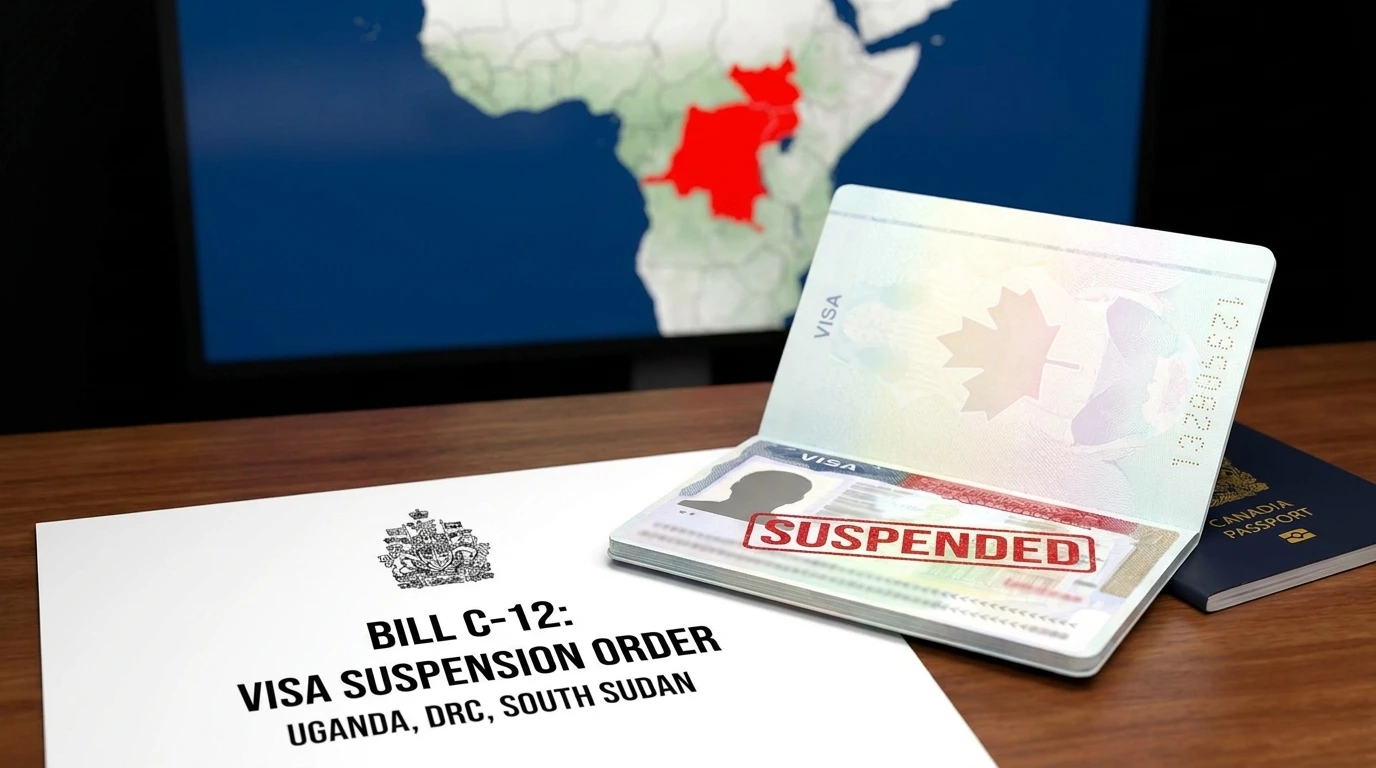

Canada has announced temporary immigration measures affecting foreign nationals currently living in the Democratic Republic of the Congo (DRC), South Sudan, and Uganda due to the risk of Ebola outbreaks in those countries.
The measures took effect at 11:59:59 p.m. Eastern Time on May 27, 2026 and will remain in place until 11:59:59 p.m. Eastern Time on August 28, 2026.
According to Immigration, Refugees and Citizenship Canada (IRCC), foreign nationals currently living in the affected countries will not be able to travel to Canada during this period, even if they already have approved immigration documents.
What the Temporary Measures Mean
Under the new measures, Canada is temporarily suspending certain immigration documents issued to foreign nationals who currently live in the DRC, South Sudan, or Uganda. This means, they will not be able to travel to Canada during this period, even if they already have approved immigration documents.
Affected documents include:
- temporary resident visas,
- electronic travel authorizations (eTAs),
- temporary resident permit counterfoils, and
- permanent resident visas.
Applicants can still submit new immigration applications, and IRCC says existing applications will continue to be processed. However, final decisions will not be issued while the temporary measures remain in place.
Once the restrictions are lifted, valid immigration documents will automatically become active again and application processing will resume normally. Applicants will not need to take any steps to reactivate them.
Important Exceptions
The measures apply based on an applicant’s country of residence, not their citizenship.
This means someone who is a citizen of Uganda, South Sudan, or the DRC but was living in another country when they applied for their immigration document is not affected by these restrictions.
IRCC says affected individuals will receive email notifications if their immigration documents have been suspended. If your document is suspended, it becomes temporarily invalid and cannot be used to board a flight or travel to Canada until the measures are removed.
Foreign nationals who were already in Canada when the measures took effect are not affected. Their immigration status remains unchanged, and they may continue staying in Canada for the period they were authorized to remain.
IRCC also confirmed that travellers who were already in transit to Canada when the measures came into force will not be affected if Canada was their final destination and they were either on a flight or waiting for a connecting flight to Canada.
However, they may be required to undergo medical screening and comply with public health requirements upon arrival.
Why This Matters
The announcement may create uncertainty for individuals with pending immigration applications, approved visas, study permits, work permits, or Permanent Residency plans connected to Canada.
Because the measures are temporary, affected applicants should continue monitoring updates from IRCC and ensure their contact information remains current in their immigration accounts.
How SehliGlobal Can Help
Sehli Global, a licensed Regulated Canadian Immigration Consultant (RCIC) based in Kitchener-Waterloo, Ontario, helps people already living in Canada understand their immigration options and move toward greater stability through work permits, Permanent Residency pathways, family sponsorships, visitor visas, and other immigration solutions.
For people already living in Canada and working toward Permanent Residency, immigration planning should continue regardless of temporary travel restrictions or policy changes.
For affected applicants in the DRC, South Sudan, and Uganda, this period may be an opportunity to ensure applications, supporting documents, and immigration plans are fully prepared so they are ready to move forward once the temporary measures are lifted.
For personalized immigration guidance, you can book an appointment with SehliGlobal here.

Leave a Comment